Social Security Changes 2026: What Retirees Need to Know

Navigating Social Security Changes in 2026: What American Retirees and Future Beneficiaries Must Know is crucial for financial planning, as potential legislative adjustments could significantly impact retirement benefits and long-term financial stability.
For many Americans, Social Security represents a cornerstone of their retirement security. As we approach 2026, discussions around potential adjustments to the system are gaining momentum, making it imperative for current and future beneficiaries to understand what these changes might entail. Navigating Social Security Changes in 2026: What American Retirees and Future Beneficiaries Must Know is not just a recommendation, it’s a necessity for informed financial planning.
Understanding the Social Security Landscape in 2026
The Social Security system, established in 1935, has been a vital safety net for millions of Americans. However, demographic shifts, including increased life expectancies and lower birth rates, have put pressure on its long-term solvency. As we look towards 2026, the discussion around potential reforms intensifies, aiming to ensure the program’s sustainability for future generations.
Understanding the current state and projected challenges of Social Security is the first step in preparing for any upcoming changes. The Old-Age and Survivors Insurance (OASI) Trust Fund, which pays retirement and survivor benefits, is projected to be able to pay 100 percent of scheduled benefits until the mid-2030s. After that, it will be able to pay about 80 percent of benefits if no legislative action is taken. This projection underscores the urgency of addressing the program’s financial health.
Key Financial Projections and Their Impact
The annual Trustees’ Report provides critical insights into the financial status of Social Security. These reports highlight the long-term actuarial deficit, which signifies that projected income will not be sufficient to cover projected expenditures under current law. This gap is primarily driven by:
- Declining birth rates leading to fewer workers supporting more retirees.
- Increased longevity, meaning retirees collect benefits for longer periods.
- The aging of the large baby-boomer generation.
These demographic trends are not new, but their impact becomes more pronounced with each passing year, making 2026 a pivotal moment for potential policy adjustments. The discussions will likely revolve around a combination of revenue enhancements and benefit modifications to close this financial gap.
Ultimately, the landscape of Social Security in 2026 will be shaped by ongoing legislative debates and the economic realities facing the nation. Being informed about these foundational issues is crucial for anyone relying on or contributing to the system.
Potential legislative adjustments and their implications
As the Social Security Trust Fund faces future solvency challenges, various legislative adjustments are often proposed to ensure its long-term viability. These proposals generally fall into two main categories: those that increase revenue and those that modify benefits. Understanding these potential changes is essential for retirees and future beneficiaries.
One common proposal to increase revenue involves adjusting the Social Security tax cap. Currently, earnings above a certain threshold are not subject to Social Security taxes. Raising or eliminating this cap would mean higher earners contribute more to the system. Another revenue-side option is to increase the Social Security payroll tax rate, a measure that would directly impact all working Americans and their employers.
Exploring Benefit Modification Proposals
On the benefit side, several adjustments are frequently discussed. One significant proposal is to raise the full retirement age (FRA). For those born in 1960 or later, the FRA is currently 67. Increasing this age would mean individuals would have to work longer to receive their full benefits or accept reduced benefits if they claim earlier. This change would primarily affect younger generations and those still in the workforce.
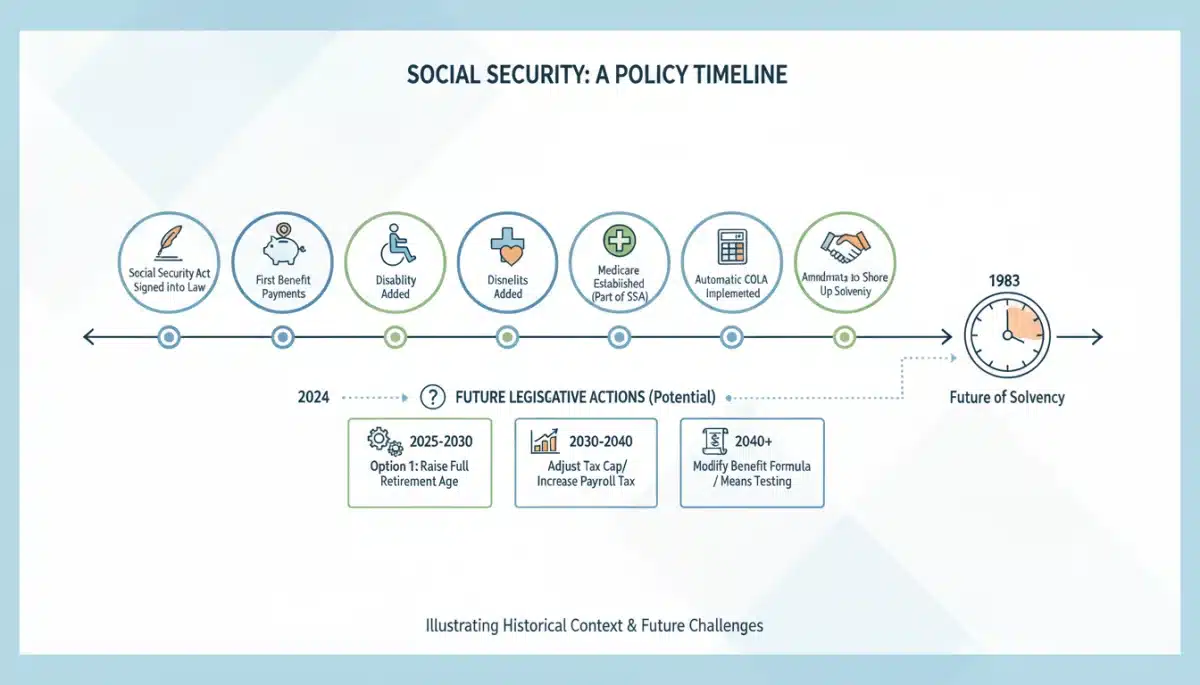

Another potential adjustment involves changing the Cost-of-Living Adjustment (COLA) formula. COLA is designed to ensure that the purchasing power of Social Security benefits is not eroded by inflation. Proposals sometimes suggest altering the index used to calculate COLA, such as switching to a “chained CPI,” which typically grows at a slower rate. This change would result in slightly smaller annual increases in benefits over time.
- Raising the Full Retirement Age: Individuals would need to work longer to receive full benefits.
- Adjusting the COLA Formula: Annual benefit increases might be smaller, impacting purchasing power over time.
- Means-Testing Benefits: Higher-income retirees might receive reduced benefits.
- Changing Benefit Calculation Formulas: Could affect the initial benefit amount for new retirees.
Each of these legislative adjustments carries distinct implications for different groups of beneficiaries. For example, raising the FRA would disproportionately affect those in physically demanding jobs, while changes to COLA would have a cumulative effect on all beneficiaries over their retirement years. The legislative process is complex, involving extensive debate and negotiation, making it difficult to predict the exact nature of any changes. However, staying informed about these potential modifications is crucial for proactive financial planning.
Impact on current retirees: what to expect
Current retirees, those already receiving Social Security benefits, often express significant concern about potential changes to the program. While legislative adjustments are typically designed to minimize disruption for existing beneficiaries, it’s prudent to understand how their benefits might be affected in 2026 and beyond.
Historically, significant changes to Social Security have often included provisions to protect current retirees from drastic reductions. This is due to the political sensitivity of altering benefits for those who have already planned their finances around existing expectations. However, “protection” does not necessarily mean immunity from all adjustments.
Potential Effects on Existing Benefits
One of the most frequently discussed areas that could impact current retirees is the Cost-of-Living Adjustment (COLA). As mentioned earlier, modifications to the COLA formula, such as adopting a chained CPI, could lead to slightly smaller annual increases in benefits. While this might not result in an immediate cut, it would mean that the purchasing power of benefits could erode more quickly over time compared to the current calculation method.
- COLA Adjustments: Smaller annual increases could subtly reduce real benefit value over time.
- Taxation of Benefits: Changes to income thresholds for taxing Social Security benefits could increase tax liability for some retirees.
- Medicare Premium Integration: While not a direct Social Security benefit cut, potential changes to Medicare premiums, which are often deducted from Social Security checks, could effectively reduce net income.
It’s important to differentiate between a direct cut to scheduled benefits and a slower growth rate. Most proposals aim for the latter to gradually address the solvency issue without causing immediate financial distress to current beneficiaries. However, even a slower growth rate can have a significant cumulative impact over a long retirement.
Current retirees should closely monitor legislative developments and consider how even minor adjustments to COLA or taxation rules might affect their overall retirement budget. Consulting with a financial advisor can help in understanding specific implications and adjusting personal financial strategies accordingly.
Future beneficiaries: planning for a new reality
For those still in the workforce, especially younger generations, the prospect of Social Security changes in 2026 introduces a new layer of complexity to retirement planning. Future beneficiaries must consider these potential adjustments not as distant possibilities, but as concrete factors that will shape their financial reality.
One of the most impactful potential changes for future beneficiaries is an increase in the full retirement age (FRA). If the FRA is raised, individuals would need to work longer to receive their full benefits or face a greater reduction if they choose to claim earlier. This requires a reevaluation of career timelines and retirement dates.
Adapting Retirement Strategies
Future beneficiaries should proactively adapt their retirement strategies to account for these potential shifts. This includes:
- Revisiting Retirement Age Projections: Consider the possibility of working an extra year or two to reach the full retirement age, or adjust expectations for early retirement benefits.
- Increasing Personal Savings: Relying less on Social Security as the sole pillar of retirement income becomes even more critical. Boosting contributions to 401(k)s, IRAs, and other investment vehicles can provide a stronger financial cushion.
- Diversifying Income Streams: Explore other potential sources of retirement income, such as rental properties, part-time work, or annuities, to reduce dependence on Social Security.
Changes to the benefit calculation formula are also a possibility. While the specific details of such changes are yet to be determined, they could alter the initial benefit amount for new retirees. Understanding how your earnings history factors into the calculation and any proposed modifications to that formula will be crucial.
- Understanding Benefit Formulas: Stay informed about how your Average Indexed Monthly Earnings (AIME) are calculated and how potential legislative changes might modify this.
- Estimating Future Benefits: Regularly check your Social Security statement and use online calculators, adjusting assumptions for potential changes, to get a more realistic estimate of your future benefits.
- Seeking Professional Advice: A financial planner specializing in retirement can help model various scenarios and develop a robust plan that accounts for potential Social Security adjustments.
By taking a proactive approach and incorporating potential Social Security changes into their long-term financial planning, future beneficiaries can build a more resilient and secure retirement.
Strategies for financial resilience amidst changes
In an environment of potential Social Security changes, cultivating financial resilience becomes paramount for both current and future retirees. This involves a multi-faceted approach that goes beyond simply understanding the legislative landscape, focusing instead on actionable steps individuals can take to protect their financial well-being.
One of the most effective strategies is to diversify your retirement income sources. Over-reliance on Social Security can be risky, especially with the uncertainty surrounding future benefit levels. This means actively building other income streams that can supplement or even replace a portion of your Social Security benefits.
Building a Robust Retirement Portfolio
A strong retirement portfolio is a cornerstone of financial resilience. This involves a combination of:
- Tax-Advantaged Accounts: Maximizing contributions to 401(k)s, IRAs (Traditional or Roth), and other employer-sponsored plans. These accounts offer significant tax benefits and allow your investments to grow over time.
- Diversified Investments: Spreading your investments across various asset classes (stocks, bonds, real estate, etc.) to mitigate risk and enhance potential returns. A well-diversified portfolio is less susceptible to downturns in any single market segment.
- Emergency Savings: Maintaining a robust emergency fund, typically 3-6 months of living expenses, can provide a crucial buffer against unexpected costs and prevent premature withdrawals from retirement accounts.
Beyond traditional investments, consider exploring other avenues for income. This could include generating passive income from rental properties, royalties, or even starting a small business in retirement. The goal is to create a financial ecosystem that is less vulnerable to external pressures, such as changes in government benefits.
Another vital strategy is continuous financial education. Staying informed about economic trends, investment opportunities, and legislative developments is key. The more you understand about your financial landscape, the better equipped you will be to make informed decisions and adapt your plans as needed.
Finally, consulting with a qualified financial advisor is invaluable. They can help assess your current financial situation, project future needs, and develop a personalized strategy that accounts for potential Social Security changes and other economic uncertainties. A professional can offer tailored advice and help you navigate complex financial decisions, ensuring your retirement plan remains robust and adaptable.
Advocacy and engagement: shaping the future of social security
While individual financial planning is crucial, understanding that Social Security is a collective program means that advocacy and engagement also play a significant role in shaping its future. For American retirees and future beneficiaries, being informed about the political discourse and actively participating in the conversation can influence legislative outcomes.
Social Security reform is a complex political issue, with various stakeholders holding differing views on the best path forward. These stakeholders include advocacy groups for seniors, labor unions, business organizations, and political parties. Each group brings its own perspectives and priorities to the debate, making the legislative process a dynamic and often contentious one.
How to Engage and Advocate
There are several ways individuals can engage in the discussion and advocate for their interests:
- Contacting Elected Officials: Reach out to your representatives in Congress. Share your personal story and explain how potential Social Security changes would affect you and your family. This can be done through letters, emails, phone calls, or attending town hall meetings.
- Supporting Advocacy Organizations: Join or support organizations that actively lobby on behalf of retirees and future beneficiaries. These groups often have significant influence and resources to promote their policy recommendations.
- Staying Informed: Beyond just reading headlines, delve into detailed analyses from reputable sources regarding proposed changes. Understanding the nuances of different proposals allows for more effective advocacy.
The legislative process is often influenced by public opinion and organized advocacy. By making your voice heard, you contribute to a more comprehensive and representative debate. This is not just about protecting your own benefits, but about ensuring the long-term health and fairness of a program that serves millions of Americans.
Engaging in the political process also means understanding the trade-offs involved in different reform proposals. For instance, increasing taxes on higher earners might be favored by some, while others might advocate for adjustments to benefit calculations. A balanced perspective, informed by an understanding of the system’s complexities, strengthens your ability to advocate effectively.
Ultimately, the future of Social Security will be determined by policy decisions made in Washington. By staying engaged and advocating thoughtfully, American retirees and future beneficiaries can help ensure that these decisions reflect the needs and concerns of those who rely on the program the most.
| Key Point | Brief Description |
|---|---|
| Solvency Challenge | Social Security faces a long-term actuarial deficit due to demographic shifts, necessitating reforms. |
| Revenue Adjustments | Proposals include raising the tax cap or increasing payroll tax rates to boost program income. |
| Benefit Modifications | Potential changes like raising the full retirement age or altering COLA calculations are discussed. |
| Financial Resilience | Diversifying income, boosting savings, and consulting advisors are key strategies for adapting. |
Frequently Asked Questions About Social Security Changes
While direct cuts to current benefits are generally avoided in legislative proposals due to political sensitivity, changes like adjusted Cost-of-Living Adjustments (COLA) could result in slower growth of benefits over time, effectively reducing their purchasing power. Future beneficiaries might also see adjustments to the full retirement age or benefit calculation formulas.
The full retirement age (FRA) is the age at which you are entitled to receive 100% of your Social Security benefits. For those born in 1960 or later, it is currently 67. There are ongoing discussions about potentially raising the FRA further to improve the system’s solvency, which would primarily impact future beneficiaries.
Preparing for potential changes involves diversifying your retirement income sources beyond Social Security. Maximize contributions to 401(k)s and IRAs, explore other investment opportunities, and maintain a robust emergency fund. Consulting a financial advisor can help tailor a specific strategy to your individual circumstances and goals.
Increasing Social Security taxes is one of the proposed solutions to address the program’s long-term funding gap. This could involve raising the Social Security tax rate itself or increasing the amount of earnings subject to Social Security taxes (the tax cap). Such changes would directly affect current workers and their employers.
Staying informed is key. Regularly review your Social Security statements, which provide personalized benefit estimates. Follow news from reputable financial and government sources regarding legislative proposals. Consider subscribing to newsletters from advocacy groups focused on retirement and Social Security for detailed updates and analyses on potential changes.
Conclusion
The prospect of Social Security Changes in 2026 underscores the dynamic nature of retirement planning in America. While the specifics of any legislative adjustments remain subject to ongoing debate, it is clear that both current and future beneficiaries must remain vigilant and proactive. By understanding the underlying challenges, exploring potential reforms, and adapting personal financial strategies, individuals can build greater resilience. Engagement in the advocacy process further empowers citizens to shape a Social Security system that continues to provide vital support for generations to come, ensuring a more secure financial future for all.